


Global Research Report
Capital Unlocks Capacity
Revealed: How energy storage investment is moving from hype to discipline

Capital Unlocks Capacity, DLA Piper’s new global research report, reveals energy storage investors are shifting capital from speculative scale to commercially viable projects they expect will be built.
The key survey findings
-
1
The United States outstrips competition as the most desirable battery energy storage systems (BESS) and storage market in the next three years.
-
2
Most investors now expect annualized returns of 11% to 12% to balance project risks.
-
3
43% favor ready-to-build projects over early-stage pipelines.
-
4
70% cite the attractiveness of load-anchored storage to meet demand growth.
-
5
Investor appetite holds steady across durations, with capital shifting toward longer-horizon, policy-tolerant strategies.
Energy storage has evolved from a nascent opportunity into a more established, institutional market where capital is abundant but increasingly concentrated in bankable projects with identifiable risk, robust revenue models, and credible delivery pathways.
Capital is flowing into the sector. But it is being deployed more selectively than five years ago, favoring markets where rules are clear and where that clarity supports reliable execution and monetization.
Investors have converged around a financial sweet spot for viable storage projects, with most seeking returns of 11% to 12% to balance delivery risk.
These insights come from DLA Piper’s global survey of 550 senior players across the BESS and energy storage ecosystem – from investors and developers to lenders and supply-chain leaders – supported by in-depth interviews with specialists at Akaysha Energy, Brookfield Asset Management, and Clearway Energy.
Capital Unlocks Capacity reveals not just where energy storage capital is flowing today, but also the structural forces shaping future development.
US tops rankings
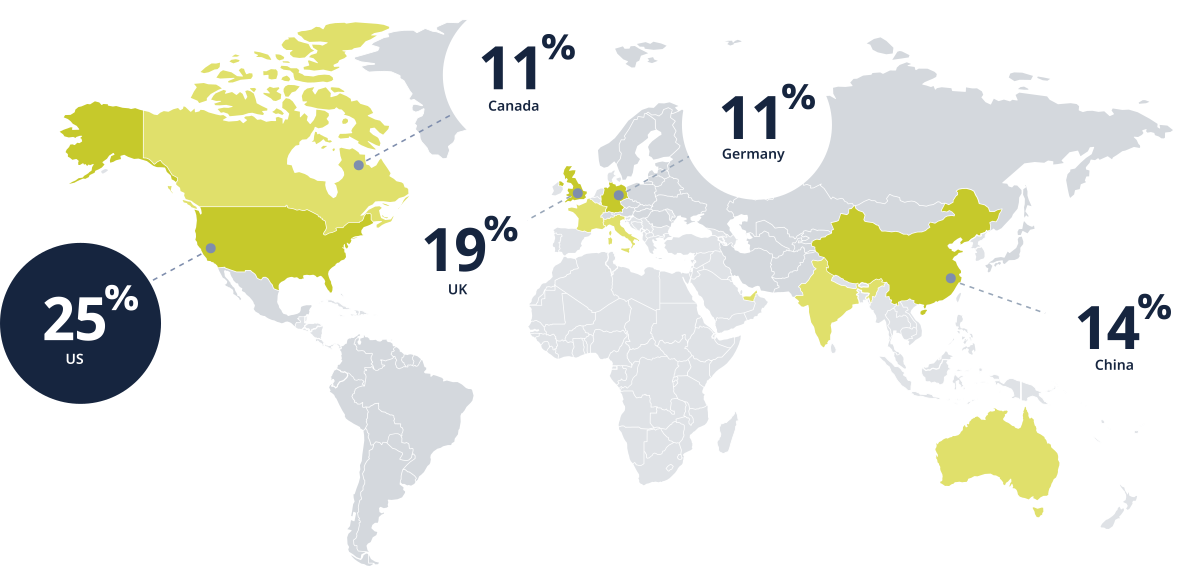
The US ranks as the most attractive market, with around a quarter of respondents favoring it. Despite respondents noting the complexities of an evolving policy environment, the US market is widely viewed as forward-looking and supportive of storage.
“For large, well-resourced developers, these challenges are manageable,” notes Steve Miller, Chief Investment Officer at Clearway Energy. “But they clearly separate disciplined execution from speculative development.”
China’s position is also notable. Ranked third by 14% of respondents, it stands out despite market access barriers for international players.
Both rankings reflect a broader pattern, with investors reporting a willingness to engage where scale is matched by tangible opportunities and clearer pathways to deployment.
Overall, this suggests not a departure from disciplined capital, but a more nuanced evolution where predictability, monetization, and execution still anchor decisions, including in markets that appear complex on the surface.
Investors demand the right rewards
Returns are converging more tightly than investors expected. The market has settled in the low-teens internal rate of return range, with nearly half of investors citing 11%-12% as adequate compensation for execution and regulatory risk.
This aligns closely with current deal activity, suggesting capital is being deployed with greater confidence rather than stretching for yield.
What stands out is the edge of the distribution. The relatively thin tail of sub-8% expectations is notable considering it may reflect a different class of investor targeting highly contracted or policy‑supported assets.
In effect, parts of the storage market seem to resemble core infrastructure – signaling how far revenue structures and risk profiles may have evolved.

Is the acceptable return rate for storage projects, according to half of respondents
Capital chases late-stage projects
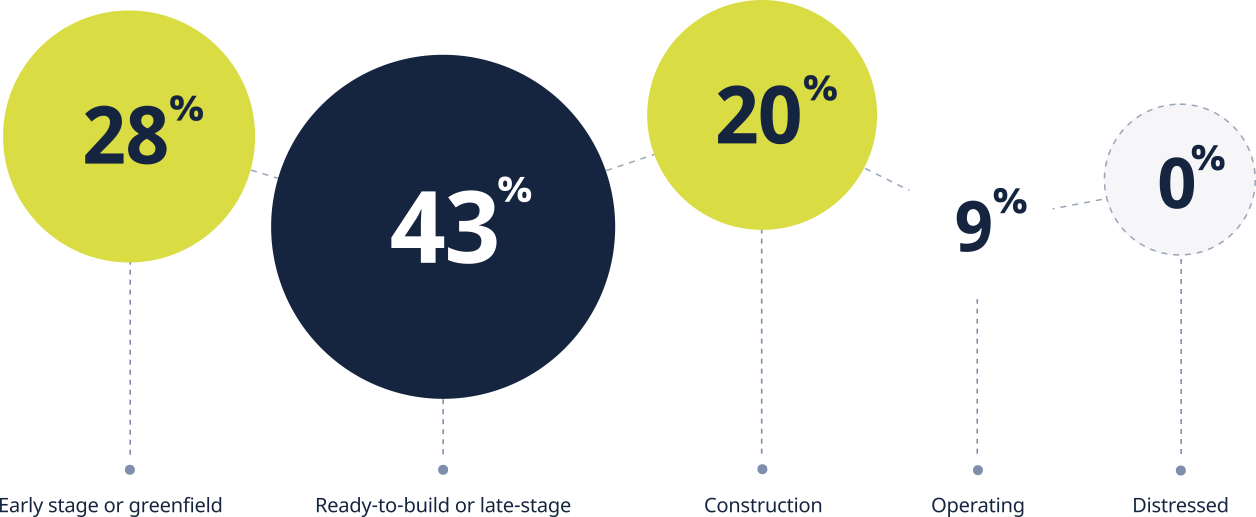
Capital is concentrating further along the development curve than investors expected. 43% of investors favor ready‑to-build and late-stage assets, where risks are visible and delivery is repeatable. This appears to mark a shift away from speculative pipeline accumulation.
Early‑stage development still attracts interest, but more selectively, while fully operational assets draw limited incremental capital and are more often treated as long-term holdings than core targets.
Most strikingly, distressed opportunities are almost entirely absent. This potentially points to a market that has matured beyond early‑stage volatility but has not yet entered a dislocation phase.
The findings suggest that this is a cycle defined by execution certainty, not opportunistic buying – for now.
AI-led projects soar – but other options thrive too
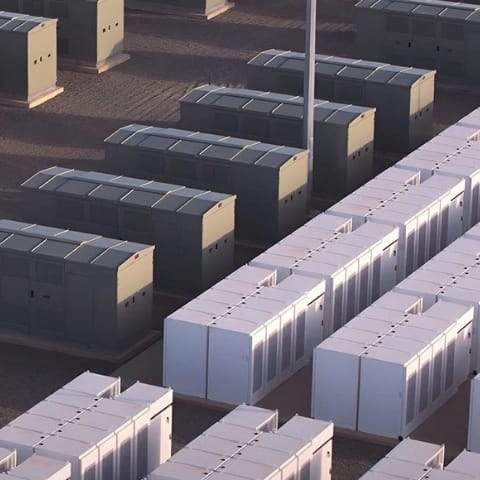
The market is not converging on a single "best" model – it is diversifying. Investors are spreading capital across configurations, often within the same portfolio, with strong support across all asset types: 71% favor co-located storage and around 70% hybrid systems. What appears to be changing is not where capital flows, but how risk is managed.
This suggests a shift away from merchant exposure. While 68% still view standalone as attractive, preference strengthens with revenue visibility, with around 70% favoring contracted models.
New configurations seem to be gaining momentum, but are not displacing the old. Respondents point to a more deliberate allocation toward demand-anchored, revenue-secure, and optimization‑driven systems, with standalone remaining core.
Of investors see co-located storage and renewables as attractive
Investors commit to emerging technologies
Our data indicates the next phase of storage is being shaped less by technology and more by market design. Short‑duration BESS remains the commercial backbone. But investor appetite does not fall away as duration increases.
Around 70% remain engaged at today’s two- to four-hour sweet spot, while nearly two‑thirds are already active in long‑duration storage. This suggests a shift in how capital is allocated across risk, time horizon, and revenue visibility.
Together, these trends suggest growing investor interest in a broader mix of storage technologies, but this shift has yet to translate into material build‑out. Deployment remains BESS‑heavy, but investors are already positioning for longer‑duration assets, as markets that can support long‑tenor revenues begin to attract more patient capital.
Read Capital Unlocks Capacity to discover where the energy storage market is heading

- Where is M&A set to be concentrated over the next few years?
- What types of revenue structure are proving most successful?
- How are project partners tackling financial risk?
- What are the biggest drivers of investor interest in storage markets?