


Featured Report
The Power Behind AI
Smart storage needs smart structures
Energy-hungry AI data centers are testing the limits of power availability, turning storage into mission-critical infrastructure. Hyperscaler partnerships can strengthen investment cases – if investors can navigate the complexity behind co-located power.
Key takeaways
-
1
Major tech companies are recognizing the value of onsite energy storage, to help achieve speed to market and deliver stable power loads for AI data centers.
-
2
Hyperscalers boost the creditworthiness of co-located projects. They bring agility, risk diversification, and behind-the-meter optimization knowhow.
-
3
Data center projects with co-located storage and generation require bespoke agreements that balance complex variables and the priorities of multiple stakeholders.
Of global storage players see co-located generation, storage, and load as attractive or very attractive investments
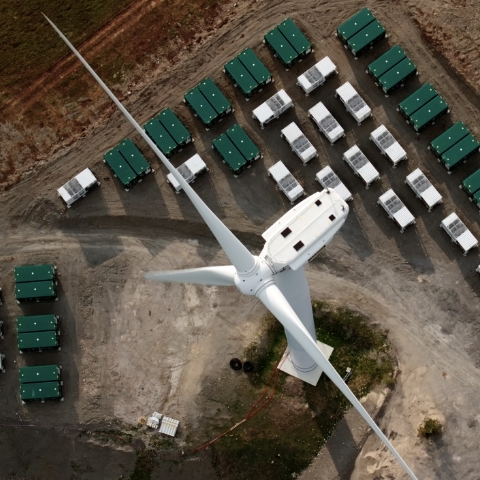
Hyperscalers increasingly see energy storage not merely as backup, but as an indispensable component of new data centers. Even a second of downtime is a luxury these facilities can’t afford, and many grids are not currently configured for the scale and variability of AI-driven demand growth. Batteries can discharge rapidly during demand spikes, offering the ability to manage surges in AI workloads.
In fact, in a strained energy system, storage is often a non-negotiable element of new data center proposals. “The interconnection imperative is increasingly a primary driver,” says Brian K. Fielden, Partner.
“New large-load connections face multiyear queue times. In the US, for example, utilities are requiring or strongly encouraging applicants to demonstrate onsite generation or storage capacity.”
A developer proposing a 100 megawatt (MW) data center campus today may need onsite storage running into tens of megawatts, and possibly dispatchable generation, to manage peak demand and make interconnection feasible.
Meanwhile, communities around the world are scrutinizing the power demands of data centers. Developers benefit if they can show that rather than becoming a drain, a scheme will be self-sufficient or support local grids. Onsite storage can help facilitate those outcomes.


There’s a lot more project management complexity. The upside is that if you do it successfully, you can deliver projects that are much more viable.
Anthony Day, Partner, DLA Piper

Big hitters bring more than demand
The value tech giants add to storage projects is not just about load. For developers of battery energy storage systems, a hyperscaler can change the commercial profile of a project. Its scale and credit strength can provide a revenue stream that gives lenders more confidence in the wider business case.
“Hyperscalers can be more flexible than utilities, who are more restricted by internal governance requirements or regulations,” says Jennifer Keogh, Of Counsel. “They also have a wider portfolio than most corporates, so they can diversify risk across different sites or jurisdictions.”
This matters because storage projects can rely on a mix of merchant upside, contracted revenues and grid services. A creditworthy data center tenant may not remove that complexity, but it can give the project a stronger commercial foundation than conventional offtake alone.
20-25 Gigawatts
Predicted capacity of battery storage installed in data centres by 2030.


25 GW
Upper estimate
20 GW
Lower estimate
No set of market-standard documents has yet emerged for co-located data center, generation, and storage projects equivalent to the established power purchase agreement (PPA) frameworks used for renewables projects. Standard documentation is unlikely to be enough: these projects require agreements tailored to their specific technical and commercial risks.
This is because the various stakeholders – hyperscaler or data center operator, engineering, procurement, and construction (EPC) contractor, utility, and provider of optimization software – enter projects with different priorities.
“You’re having to do a more complicated scheme with different power sources and knit it all together, so the project management is a lot more complicated,” says Anthony Day, Partner. “The upside is that if you do it successfully, you can deliver projects that are much more viable.”

Smarter assets, harder decisions?
Hyperscalers can also influence how storage assets perform. Their access to advanced AI optimization tools creates the potential for more efficient asset management.
For onsite behind-the-meter batteries, this can translate into precise load tracking and forecasting. In turn, this helps data centers capture lower-priced hours and reduce peak grid demands.
But the question of operational control becomes more complex where storage is operated as an offsite, front-of-meter asset with market-facing revenues, or under a tolling-style arrangement. In those structures, AI-driven asset management decisions can affect both asset efficiency and trading returns.
Even when big tech organizations subcontract optimization, their technical sophistication and inherent understanding of data center load mean they are unlikely to be passive participants in the value chain. “Hyperscalers are the savviest of offtakers,” notes Keogh.
But she sees tensions emerging where a dispatch agreement involves profit share: “Both parties naturally want to be involved in the direction of the trading strategy.”
“They need to calibrate optimizing performance with the performance of the asset itself. If battery efficiency is 1% less than expected but trading is 10% less than expected, what’s the correlation? How do you share the liability?”
To avoid disputes over operational control in these market-facing structures, partners need to define control arrangements in detail from the outset. Contracts must spell out who holds dispatch priority under specific operating conditions, what protocol must be followed if instructions conflict, and who bears the cost of suboptimal dispatch.
“These are questions that a commercial or construction practitioner can resolve at the documentation stage,” says Fielden. “After the asset is commissioned, they may become materially more expensive to adjudicate.”
Of respondents say data center and AI-driven demand is having a significant or dominant impact on storage investment strategy

Fast fix may stick around too long
Dispatch control is not the only issue that needs to be resolved upfront. The pressure to move quickly can turn interim power solutions into long-term liabilities.
Storage and onsite generation may offer a way to bypass the grid altogether, at least at first, giving tech firms the speed-to-market they need.
But this strategy comes with risks. Interim measures may well become indefinite, says Fielden: “Onsite generation deployed as a bridge frequently becomes the primary power source for far longer than planned – requiring battery augmentation or replacement, and potentially re-permitting of gas generation initially authorized as temporary.”
An extended bridge period also risks wear and tear on the battery. Elevated cycle counts, deeper discharges, or higher thermal loads than anticipated can erode or void warranties. When the developer tries to move the asset to permanent service, those augmentation costs remain unallocated.
Throw in the complexity required to balance battery, generation asset, site electrical infrastructure, and data center load, and the result is a recipe for potential construction disputes. A watertight contract that anticipates these conflicts from the start is critical.

The commercial terms governing flexibility, renegotiation, and step-in remedies can carry greater consequence with hyperscaler counterparties than with traditional offtakers.
Brian K. Fielden, Partner, DLA Piper
Creating contracts that survive future change
Agreements must look beyond commissioning, anticipating business and market changes long after the assets go live.
For example, if a data center tenant were to shift its computing strategy from AI model training to lighter inference workloads, or partly decommission a facility, its power draw might drop below the level that justified the onsite storage investment. The contract needs to address who bears that risk.
Market revenues may strengthen the investment case, particularly where storage operates as a front-of-meter asset exposed to grid services. But where future rule changes could affect those revenues, the key contractual issue is how that regulatory and revenue risk is allocated.
When commercial or operational assumptions change, hyperscalers will take action to protect their interests.
“Hyperscalers often enforce contracts decisively under adverse conditions,” Fielden notes. “The commercial terms governing flexibility, renegotiation, and step-in remedies can carry greater consequence with hyperscaler counterparties than with traditional offtakers.”
Even so, the benefits of collaboration are undeniable for storage investors and AI innovators alike.
“For tech companies, storage is now much more than a sustainability add-on: it’s strategic infrastructure,” Keogh concludes. “And from the storage developer perspective, it’s a partnership that’s going to drive growth and innovation in the market, helping to commercialize long-duration storage.”
Get advice on energy storage infrastructure
DLA Piper advises investors, developers, and sponsors across the energy storage value chain, from project structuring and joint development agreements to grid, permitting, offtake, and revenue stack risk.
Contact the team