


Research report
Germany’s storage market
Strong development potential, selective capital
Survey data and insights on how German investors assess market attractiveness, investment strategy, and financing risk.
Key takeaways
1. Data-center growth and grid access are central to market attractiveness.
Data-center growth is the main driver of investment in storage projects – cited by 32% of German respondents. Grid access and connection conditions follow closely at 30%.
2. German investors are comfortable with moderate merchant exposure and have conservative return expectations.
59% would accept 21-60% of revenues being uncontracted. 63% target an 8-10% IRR, compared with 27% globally.
3. Capital is focused on greenfield opportunities and secured grid connections.
53% prefer greenfield assets, versus 28% globally. Looking ahead, 37% expect capital deployment to shift towards projects with secured grid connections, compared with 29% globally.
4. Extended duration storage attracts interest, but appetite varies considerably by duration.
47% of German respondents are actively pursuing, or prioritizing, 6-8 hour storage. By contrast, 43% avoid 1-2 hour assets, compared with 13% globally.
5. Investors expect consolidation to be driven primarily by asset-level opportunities.
36% identify distressed asset acquisitions as a likely consolidation pathway. That’s followed by mergers between established developers or platforms, and joint development agreements (both 32%).
6. Financing discussions focus more on downside protection than merchant pricing risk.
41% identify security and collateral packages as an area of disagreement between sponsors and lenders, versus 28% globally. Merchant price exposure is cited by only 11%, compared with 26% globally.

1. Data-center growth and grid access are shaping market attractiveness
For German resondents, data-center growth is the factor most often associated with an attractive BESS investment market. But grid access remains a critical condition for converting that demand into investable projects.
German investors in energy storage rate the trajectory of data-center growth as their number one factor when assessing market attractiveness. A third (32%) point to data-center growth, compared with 27% of the global survey sample (see figure 1).
The result highlights a link between storage demand and the expansion of AI-linked digital infrastructure. Data centers require dependable access to electricity, while the wider growth in power demand is putting pressure on generation and network capacity. Storage has a role both in supporting the wider power system, and helping large electricity users manage reliability, flexibility, and energy costs.
As such, the business case for combining data-center and storage assets is strong, says Jason Morris, Head of Asset Acquisition and Partnerships at Flower. "A co-located battery can shave peaks, reduce a data center’s reliance on the grid, and continue earning market revenues when not needed onsite."
That presents what he calls an optimization challenge: serving the site first, and capturing value in the remaining hours. "The right balance is an especially compelling proposition in Germany, where data centers and storage compete for the same scarce connections."
He sounds a note of caution, however. Aligning the two sets of interests can be difficult. "A data-center operator’s priority is uptime and firm power; a storage owner needs the flexibility to trade the asset in the market. Attempting to reconcile these perspectives is where many discussions stall, he points out."
Ranking almost as highly as data-center growth is grid access and connection conditions, cited by 30% of German survey respondents. This underlines the practical importance of securing a viable route to connection. A positive demand outlook alone isn’t enough to make a storage project investable without a realistic path to timely and commercially workable grid access.
German participants place less emphasis on strong offtake options when evaluating BESS markets. Only 16% select this criterion, compared with 30% overall. That doesn’t necessarily mean a lack of interest in contracted revenues. But demand growth, grid access, and connection terms are of greater concern to German investors.
2. Investors accept moderate merchant exposure in a lower-return environment
German investors will accept moderate merchant exposure in a market characterized by comparatively low and tightly concentrated return expectations.
German investors are willing to accept a meaningful degree of revenue exposure on storage projects. Three in five (59%) are comfortable with 21-60% of revenues being uncontracted – though this is lower than the global proportion (78% – see figure 2).
Some caution remains. German appetite for merchant exposure is more evenly distributed than the global picture. While a majority of respondents are comfortable with some exposure, 26% favor fully contracted or highly de-risked structures (ie 0% merchant exposure). And only 4% are happy with more than 60% merchant exposure, compared with 7% globally.
These findings reflect a preference for balancing contracted revenues with exposure to market upside, rather than concentrating at either end of the risk spectrum.


Investors are increasingly accepting more merchant risk, particularly from market-driven arbitrage, while lenders will only take on that risk to a limited extent and require structured revenue components, such as tolling models or comparable hedges.
Manuel Indlekofer, Partner, DLA Piper
Return expectations are concentrated at the lower end of the spectrum. Almost two thirds of German respondents (63%) target an 8-10% IRR, compared with just 27% globally. The contrast is especially sharp when we look at the 11-12% band. Half of the global sample targets this range, compared to only 16% of German respondents.
German investors seem prepared to accept materially lower returns than their international peers. While most are comfortable with a degree of merchant exposure, they are less willing than global respondents to accept either very high merchant risk or fully merchant revenue structures. These findings suggest that German investors generally place a higher value on risk mitigation and revenue stability and are willing to accept lower returns in exchange.
3. Capital is targeting greenfield projects with secured grid access
German capital is focused on creating value during early-stage development. But the strongest opportunities are likely to demonstrate a credible, secured route to a grid connection.
German investment appetite is heavily weighted towards the beginning of the project lifecycle. More than half of respondents (53%) prefer early-stage development or greenfield opportunities, compared with 28% globally.
This suggests German investors see substantial potential for value creation in originating, shaping, and progressing storage projects through development, rather than from long-term contracted revenues. Entering at the greenfield stage gives them greater control over project design, commercial strategy, and the process of securing land and grid access.
Interest falls sharply once projects enter construction. Only 3% of German respondents favor construction-stage assets, compared with 20% globally.
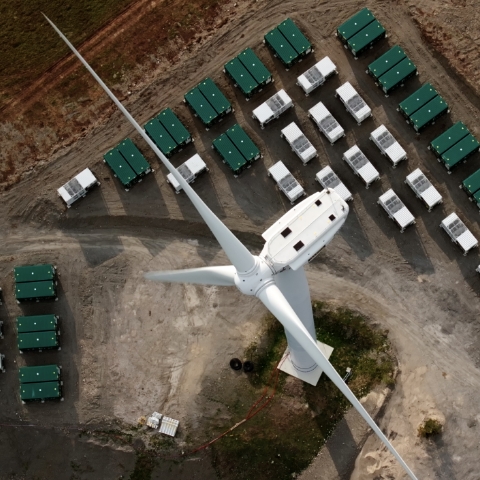
of German respondents prefer greenfield opportunities, compared with 28% globally. Only 3% prefer construction-stage assets, versus 20% globally.
Clearly, German investors make a strong distinction between development risk and delivery risk. They’re willing to take on the uncertainties associated with early-stage projects where they can have more influence over the outcomes. But they show limited appetite for taking projects through the construction phase.
This may be down to German BESS projects’ dependence on merchant and trading revenues, as opposed to long-term capacity payments or contracted revenue streams. Investors see a significant proportion of returns coming from the right location, secured grid access, effective project design, and an optimal commercial strategy prior to construction.
In addition, many utility-scale projects are only now moving through development in Germany, meaning fewer operating assets available for acquisition. Investors seeking exposure to the sector often need to enter earlier in the lifecycle.
Grid status is also important to future capital allocation. We asked how capital deployment into storage development is expected to shift over the next three to five years. Around two in five German respondents (37%) highlighted projects with secured grid connections, compared with 29% globally.
Grid access is a scarce resource in Germany. As renewable deployment, electrification, and large loads such as data centers expand, obtaining a connection point is among the biggest hurdles facing storage projects. Yet as Jason Morris puts it: "Grid access is the entry ticket. Without a credible connection, there is no project."
A confirmed connection will reduce permitting risk, shorten the route to construction, and bolster confidence in project delivery. As such, investors are likely to view grid access as a significant de-risking factor: it signals that a project has overcome one of the most challenging steps in the development phase.

In Germany today, grid, technology and commercial strategy are inseparable. Projects that reach FID are backed by teams who understand the full environment: the connection process, hardware, debt structure – and how the asset will earn once energized.
4. Appetite differs sharply between different storage durations
German capital is focused on creating value during early-stage development. But the strongest opportunities are likely to demonstrate a credible, secured route to a grid connection.
German investors take a selective approach to storage duration. When asked to describe their current capital appetite across storage durations, nearly half of respondents (43%) avoid 1-2 hour storage assets, compared with just 13% globally.
Limited appetite for the shortest-duration category may reflect caution on two fronts: the investment proposition is less differentiated; and respondents are less confident in the long-term revenue case.
1-2 hour batteries are now an established offering, with many projects pursuing similar operating strategies. These focus on frequency response, grid balancing, and short-duration energy shifting. Investors may be concerned about the impact of competition on revenues and see fewer opportunities to sustain returns.
Longer-duration technologies, on the other hand, offer a wider range of potential applications. Indeed, interest is stronger in extended-duration storage. Almost half (47%) of German market participants are actively pursuing 6-8 hour storage projects or making them a core priority.
These findings point to meaningful interest in assets capable of shifting electricity over longer periods, and offering a broader operational role than shorter-duration batteries. That said, their investment case still depends on the availability of revenues to justify their costs and risk profile.
Despite the prominence of 6-8 hour storage, German respondents are less likely than their global counterparts to describe any duration category as a core priority. The proportion doing so ranges from 10-13% in Germany, compared with approximately 24-31% globally.
This signals a cautious allocation strategy, rather than a broad commitment to a particular storage category – which may be partly due to grid-connection uncertainty. Germany has a large backlog of connection applications and constrained connection capacity. Significantly, regulators are still revising grid-connection procedures, network tariffs, and the exemptions applied to storage.
Meanwhile, the government legislated to introduce the country's first capacity market in July 2026.
Investors may be reluctant to prioritize a particular duration until the impact of these developments on project economics becomes clearer.
According to Morris, Germany's storage market will ultimately feature a mix of short and long-duration assets. Short duration will be essential for rapid grid balancing, while longer-duration technology will become more valuable as solar generation grows, and capacity mechanisms emerge.
Increasingly, choice of duration will be critical to a project’s success. It will shape the asset’s revenue case, financing, and ultimately value. The greatest opportunity today lies in factoring in the right duration at the outset.
5. Consolidation is expected to create asset-level opportunities
German respondents expect consolidation to create acquisition and partnership opportunities, with market pressure appearing more likely to affect the ownership of assets than to result in broad developer failures.
We asked survey participants how they anticipate consolidation taking shape in BESS markets. German respondents believe distressed asset acquisitions are the most probable route – cited by 36%, against 27% globally.
The result suggests that investors see financial pressure creating opportunities to acquire individual projects or asset portfolios. Where projects remain viable, developers, lenders, and investors have an incentive to preserve their value through a sale or recapitalization, instead of allowing them to fall out of the market altogether.
Market stress could therefore lead to greater ownership concentration at the asset level. At the same time, not all development platforms will survive intact. Well-capitalised investors may acquire individual projects or portfolios while weaker developers shed assets, restructure their businesses, or in some cases exit the market altogether.
Two factors came in joint second on German investors’ list: mergers between established developers or platforms; and joint development agreements (JDAs) replacing early-stage platform buyouts. Both were identified by 32% of survey participants in Germany.
The findings demonstrate how consolidation may take several forms. Some investors will pursue conventional acquisitions. Others will prefer partnerships offering access to projects and development capabilities, without the outright purchase of an early-stage platform.
Only 14% of German respondents expect sponsor consolidation to be driven by execution failures or a lack of grid access, compared with 26% globally. Together with their emphasis on distressed asset acquisitions, mergers, and JDAs, this suggests they expect consolidation primarily through asset transactions and negotiated corporate or partnership structures. It points less towards the absorption of sponsors unable to advance project pipelines.

of German respondents identify distressed asset acquisitions as a likely consolidation pathway. 32% point to mergers between established developers or platforms, and to joint development agreements.
6. Lenders are focused on security and collateral protection
German financing discussions focus principally on protecting lenders against downside risk. Security and collateral structures are gaining more attention than merchant price exposure.
Our survey also explored the causes of disagreement between sponsors and lenders in German BESS financing. Security and collateral packages proved by far the most divisive issue, cited by 41% of German participants – way ahead of safety standards and permitting alignment in second place (26%).
The outcome underlines lenders’ concerns about their ability to protect value if a project underperforms. Germany has one of the most active storage development pipelines in Europe. But many projects remain heavily exposed to merchant revenues, evolving market rules and developing contractual structures. As such, lenders may place greater emphasis on security over project assets, share pledges, account security, step-in rights, and the enforceability of collateral packages. That’s especially true where predictable contracted cashflows are limited.
Cash flow, and therefore debt service, must be secured. Most banks therefore require tolling structures for at least part of the capacity.
Michael Cieslarczyk, Partner, DLA PiperAnother consideration may be growing competition among lenders and sponsors pursuing a relatively mature set of storage opportunities. Where there’s less debate over the commercial rationale for a project, discussions will focus on financing mechanics – including the scope of security, intercreditor arrangements, and enforcement rights.
Taken together, these factors put the structure and enforceability of security arrangements at the center of financing discussions in storage transactions.
At the other end of the scale, merchant price exposure is seen as a source of sponsor-lender disagreement by only 11% of German respondents, compared with 26% globally.
That doesn’t mean lenders consider merchant revenues unimportant. But as the market matures, and participants gain experience with storage revenue models, disagreements may center more on protecting lenders’ positions if performance or revenues fall short.
In Germany, the traditional BESS model – smaller assets, funded mostly through equity – no longer holds.
Three years ago, storage assets' revenues leaned heavily towards ancillary services such as grid balancing. Heavy merchant exposure and limited long-term visibility meant lenders took a cautious view.
But as more storage has come online, ancillary markets have saturated, and revenues have shifted to wholesale and intraday trading, which are less predictable.
Today, a bankable strategy pairs a contracted base – typically a tolling agreement or revenue floor – with upside sharing over a period, and a merchant tail that lenders will underwrite conservatively.
In this climate, who trades the asset is part of the credit story: lenders will now scrutinize the optimizer's track record. Regulatory risk is also explicitly priced, from construction cost contributions to the future of grid-fee exemptions.
And over time, the financing toolkit has broadened, from tolls and floors to more sophisticated financial instruments on the lending side. This has given market players many more options than they had in the past.
Get specialist advice on Energy Storage M&A
Speak to our energy and infrastructure lawyers about navigating energy storage M&A, from grid access and revenue models to co-location, due diligence and deal execution.
Contact the team